



How we built the CEO Apparition, our most-booked corporate routine

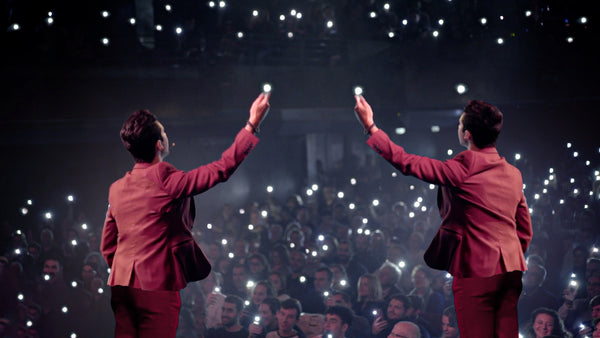
Third piece in the lesfrenchtwins.com founders series. Tony and Jordan on the routine that gets booked more than any other piece in our set, which we call the CEO Apparition. What it is, how it was built, what we have learned across roughly forty bookings between 2019 and 2026.
The premise
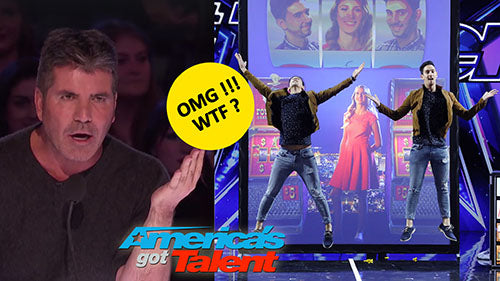
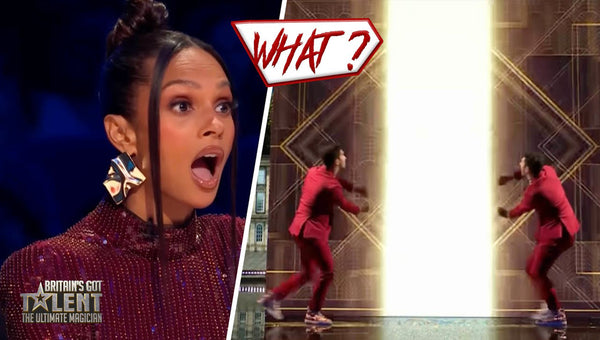
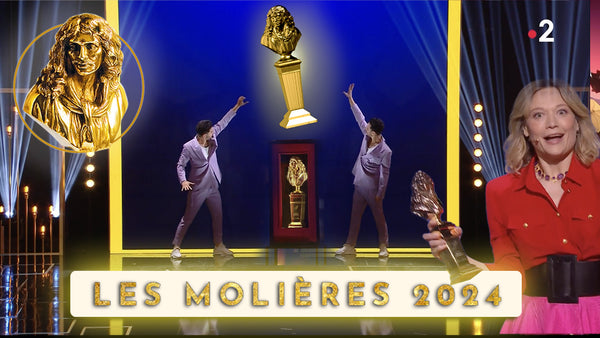
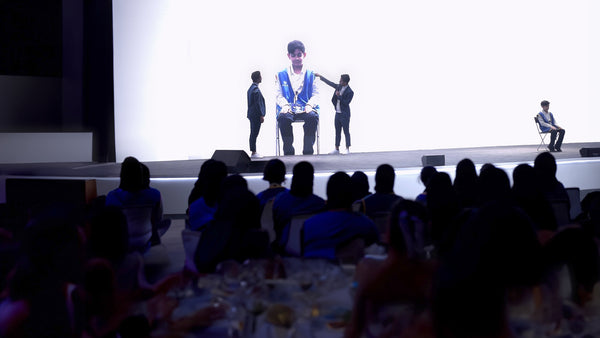
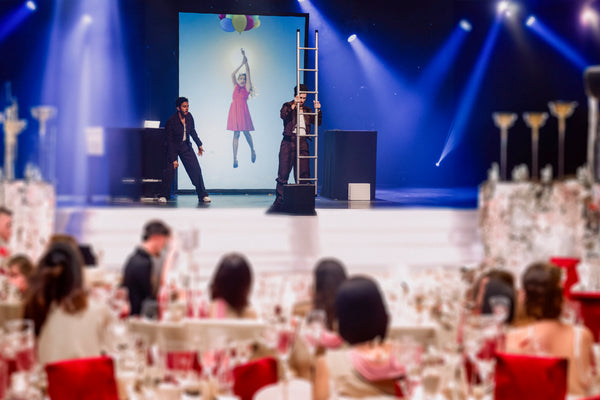
A guest CEO is invited on stage. They stand in front of an LED panel. The lights go down. A visual sequence runs on the panel that, by the end of forty-five seconds, has the CEO appearing inside the screen, walking around inside the screen, and reappearing physically on stage from a different position. The audience sees a single human being briefly become two.
That is the premise. The execution requires roughly three years of iteration, five custom software passes, and one specific lesson we learned the hard way at a German pharmaceutical client in 2021.
The origin of the idea
The first version was built for a Cartier private gala in Monaco in 2019. The brief from Cartier was specific. They wanted something that would make the CEO who was being honored that night, and we will not name him, feel like the event was, in his words, a once-in-a-decade evening. The producer of the gala asked us if we could put the CEO into a piece of digital art.
We said yes before we knew how. That is, in our experience, the correct answer when a client asks for something we cannot yet do. The yes commits you. The work follows.
The first version of the routine, in 2019, used a green screen behind the CEO and a pre-rendered animation. The audience could tell. The applause was polite. We were embarrassed. We rebuilt the entire piece over the following four months.
The second version
The second version, which we shipped at a L'Oréal internal sales meeting in early 2020, used a depth-sensing camera and a real-time compositor. The CEO was captured live and rendered into a scene that was generated procedurally. It worked technically. It still did not work emotionally.
The reason it did not work emotionally is something we did not understand until a producer at L'Oréal told us, two months later, that the room had been confused. They were confused about whether the CEO was really inside the screen or not. The trick was too clean. The boundary between the live person and the rendered person was invisible. That is, counter-intuitively, a problem.
Magic does not work without the perceived impossibility. If the audience cannot tell what is real and what is not, they do not feel the magic. They feel the technology. Those are different sensations.
The third version
The third version, which is the one we still perform in 2026, deliberately leaves a single beat where the audience can see the CEO physically on stage at the same time as the CEO is inside the screen. The beat lasts three seconds. It is the moment that makes the routine work.
We accomplish this with a stage twin. A second performer who has been on stage the entire time, dressed in a way that makes them visually similar to the CEO without being a body double. The audience does not register the second performer until the three-second beat. At that point, the second performer becomes the CEO, briefly, in the audience's perception. Then they vanish.
The piece is, technically, a misdirection routine wrapped around a real-time compositor. We will not detail the second performer's blocking because we still use it in our private engagements every year.
The lesson from Germany
In 2021, at a private engagement in Munich for a German pharmaceutical client we cannot name, the CEO who was supposed to come on stage refused. We had not been told. He had decided ten minutes before the slot that he did not want to be inside the routine. The producer asked us if we could run the piece with someone else. We had ninety seconds to decide.
We picked his chief of staff. She had been briefed on what to do, by us, as a backup, three days before. We had a backup brief because, by 2021, we had learned that the named principal in a corporate engagement will sometimes prefer to stay in the audience. The chief of staff walked on stage. The routine ran. The room did not know the principal had been the original plan.
That lesson, that the named principal will sometimes prefer to stay in the audience, is now part of every contract we sign. We always brief a backup. We always have a second compositor preset for the backup's height and skin tone. The backup gets a thank-you envelope for the inconvenience. Every time.
What the piece costs
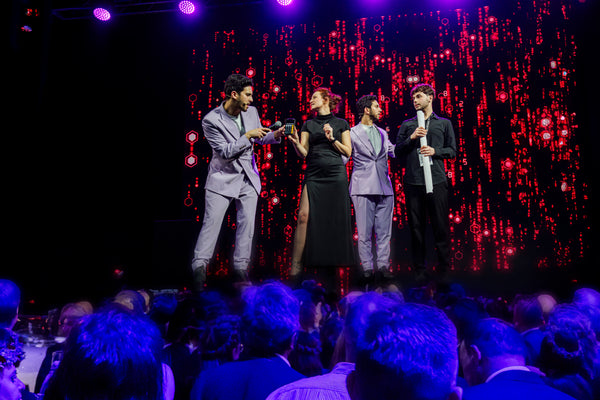
We are sometimes asked. There is a standard corporate version, the Digital Magic Show STANDARD package, which includes a fifteen-minute opening set with the CEO Apparition as the closer. And there is the Sur Mesure version, at a significantly higher fee, where the routine is written specifically for a named principal, with eight weeks of pre-production and a custom narrative arc.
A meaningful share of the fee goes into production on our side. The rest is the years of rehearsal and the years of failed versions that led to the working version. We are not apologetic about that. The fee is the fee.
The lineage
We did not invent the underlying technology. Real-time compositing existed before us. Depth-sensing cameras existed before us. Stage twin work has been done by other magicians, notably by Marco Tempest in his TED demonstrations in the 2010s, in a different format. What we did was package the pieces into a stage language that reads as magic and not as a technology demonstration. That packaging is the piece of intellectual property we are most protective of.
We have been asked by three colleagues, in the past two years, if we would license the routine. We have said no, three times. The CEO Apparition is the piece we want associated with our name. Not licensed out.
What is next
We are currently working on a fourth version that integrates volumetric video on the LED panel instead of real-time compositing. The volumetric capture allows the CEO to walk around inside the screen at any angle, which the current version does not allow. The development cycle is roughly nine months. We expect to ship it at a private engagement in late 2026.
The fourth version will, we hope, be the version that is studied. We will write about it here when it is shipped.
Next in the series: the Place Vendôme dinner where Emma Watson said we were sorcerers, and the technical disaster the audience never noticed. Coming next week.