








The routine that made Sophie Marceau cry

Seventh piece in the lesfrenchtwins.com founders series. Tony and Jordan on a private engagement in Paris in 2025 where the closing piece of our set produced a reaction we did not expect from a guest who has seen everything.
The engagement
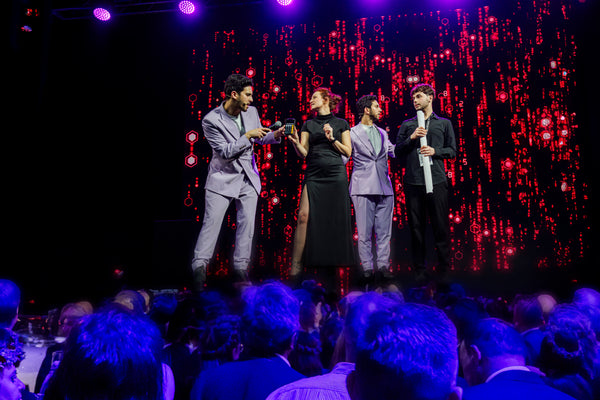
A private dinner in a private apartment in the 7th arrondissement of Paris. April 2025. Twenty-six guests. The host was an old client of ours. The occasion was, in the discreet language of the producer who booked us, a personal milestone for a family member. We were the only act on the run-of-show. We had ninety minutes of allocated stage time across the evening, broken into two sets, one before dinner and one after.
Sophie Marceau was at the second seat from the head of the long table. Black dress. No jewelry except a thin chain. She arrived with her partner and was, throughout the dinner, talking mostly to the host and to the guest seated on her other side. She did not look at the stage during our first set. We did not mind. The first set is a warm-up. The audience does not know us yet. They are still eating.
The second set
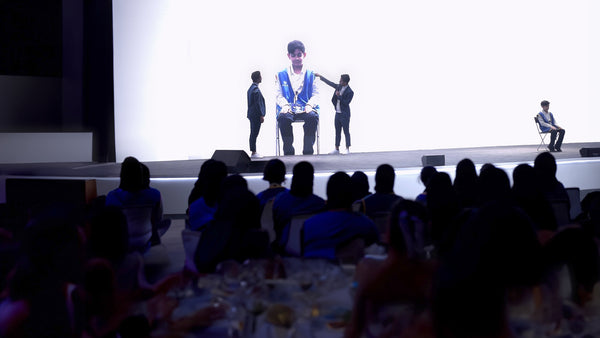
After the dessert, after the toasts, after the lights dimmed slightly for the second set, we ran through our standard private dinner sequence. The Verified Number. The Digital Twin. The Constellation. Then the closing piece, which on that night was The Closing Image, the routine where a personal photo on a guest's phone is recreated by an AI model and projected on a small LED screen we had set up at the head of the table.
We had been told, in the pre-engagement brief from the producer, that the host had a specific guest he wanted to honor that night. We did not know who. We do not, generally, want to know. The brief said that whichever guest we picked for the closing routine, it should be a guest who would not be embarrassed by an emotional moment. The producer trusted our reading of the room. We thanked her.
For the closing, we picked Sophie. Two reasons. The first is that she had warmed up during the second set in a way we recognized from experience. She was leaning in. She was making eye contact with the routines. She was, by the third piece, actively rooting for the magic to work, which is the audience state we look for. The second is that she had a particular look in her eyes when we made our way through the cards routine earlier, a look that we have learned to read as someone who has lived a lot and remembers it.
The image
For The Closing Image, the guest unlocks their phone for us mid-routine and, with their participation, one personal image from their photo library is recreated by an AI model that runs on our touring MacBook and projected on the screen. The image that surfaces is, by design, one with a strong emotional charge, a photo of a child or a parent or a sibling that the guest has clearly returned to many times over the years. How the piece finds it is part of the method we do not write down.
We know this sounds analytical. The piece does not feel analytical in the room. The guest experiences it as their own photo, recreated in front of them and the audience, on a screen, in a way that strips out the photo's specific context and renders only its emotional core.
The image that appeared, from Sophie's phone, was a photo of her son as a young boy, taken many years ago. He is an adult now. It was, visibly, a photo she had carried with her for a long time.
The render took eleven seconds. The audience watched the screen. The image appeared. Sophie did not say anything. She put her hand on her chest. She closed her eyes for two seconds. When she opened them, she was crying.
The silence
The room held a silence we have rarely felt. It was not the silence of confusion. It was the silence of recognition. Sophie was not the only one in the room crying. The host was crying. The host's partner was crying. The producer was, we noticed afterward, also crying.
We did not move. We did not say anything. We let the silence run for, in our timing, eleven seconds. The audience did not need us to fill the silence. They needed the silence.
When Sophie stood up, she stood up to hug us. Both of us. She did not say anything coherent. We did not need her to.
What we learned
The emotional register of magic, at the fee bracket where the audience has seen everything, is not produced by the technical impressiveness of the trick. It is produced by the specificity of what the trick reveals. The CEO Apparition impresses people. The Closing Image, when it works, reaches them.
We have come, over the past three years, to value the second category over the first. The first category gets us booked. The second category gets us remembered. The remembering, in the long run, is what produces the calendar we want.
We have also come to value the eleven-second silence. Many performers choose to fill the silence. We learned, that night with Sophie, that the silence is the routine. The audience does not need to be entertained out of the emotional moment. They need to be held inside it.
What Sophie said the next morning
She emailed us the following morning, before nine in the morning, through the producer. The email was short. We will not quote it in full because it was personal. What we can quote is the closing sentence, which she said we could share if we wrote about that night.
She wrote, you gave me my son for eleven seconds, twenty years after I lost him as a child to time.
We have not crossed paths with Sophie since. She has not been at another engagement we have done. We hope she will be. The email is in a folder on our desktop that we open occasionally when we are tired and we have been on too many planes and we want to remember why we do this.
That is what happened that night. The rest is what people see.
Next in the series: the brief from IBM Think 2024 and what they actually asked us to do. Coming next week.